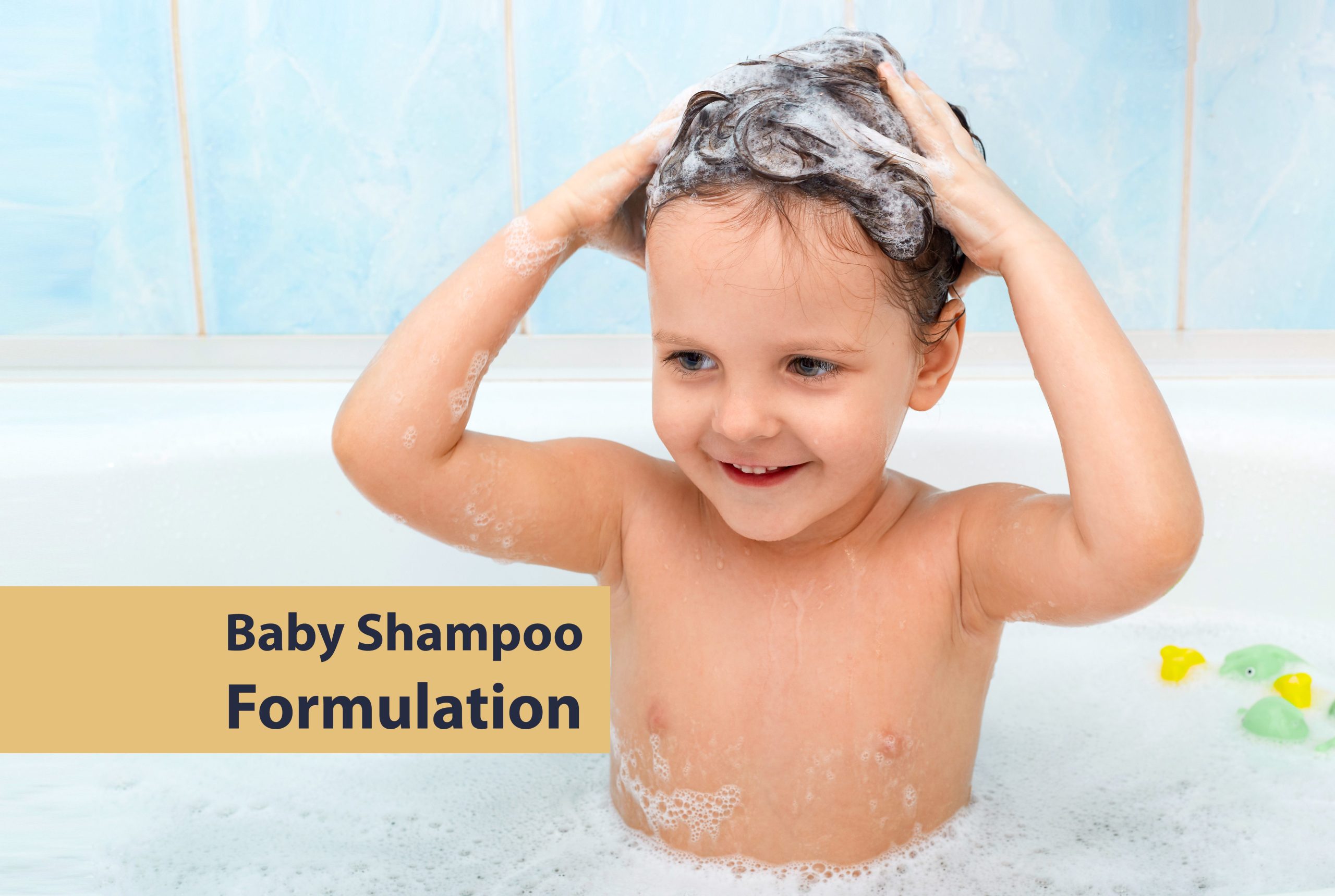
Formulating a baby shampoo requires a much different and more sensitive approach than formulating shampoos for adults. The main goal in baby shampoo formulation is to provide gentle and effective cleansing while ensuring that it does not cause eye irritation or damage the delicate skin barrier and fine baby hair. These products should have a neutral pH or a pH close to that of the skin to maintain the natural balance of the scalp. In addition, new trends in the consumer market have encouraged manufacturers to use natural active ingredients free from sulfates, parabens, and controversial preservatives, as well as biodegradable and sustainable ingredients.
As a result, the main focus is on selecting appropriate detergent raw materials for baby shampoo with extremely mild surface-active agents (surfactants) and soothing and conditioning ingredients that ensure maximum safety for the most sensitive users. In this article, we introduce the principles of baby shampoo formulation.

Principles of Baby Shampoo Formulation:
The primary and most critical principle in baby shampoo formulation is ensuring maximum safety and mildness for the eyes and sensitive scalp of infants. These formulations should strictly avoid aggressive surfactants such as sulfates (SLS/SLES) and instead use mild secondary and amphoteric cleansers such as betaines to achieve the well-known “No Tears” property. In addition, the product pH must be carefully adjusted to be close to the natural pH of an infant’s scalp, approximately neutral to slightly acidic, to prevent damage to the delicate skin barrier. The use of conditioners, moisturizers, and soothing botanical extracts such as aloe vera and chamomile is also considered an integral part of these sensitive formulations to reduce inflammation and hair tangling.
-
Surfactant Selection
Surfactants (surface-active agents) are the main foundation of every shampoo, but their selection in baby shampoo formulations is subject to strict safety considerations. While adult shampoos often use strong anionic surfactants such as Sodium Lauryl Sulfate (SLS) or Sodium Laureth Sulfate (SLES) because of their cleansing power and abundant foam, baby shampoos should completely avoid these ingredients. Instead, baby shampoo formulations should be based on much milder surfactants, including:
-
Cocamidopropyl Betaine (AMPHONILCF+)
A mild amphoteric surfactant derived from coconut oil with excellent foam stabilization properties. This compound helps balance adequate cleansing and the prevention of excessive dryness in baby shampoo formulations.
-
Cocamidopropyl Hydroxysultaine (AMPHONIL CAS)
An amphoteric surfactant that is milder than AMPHONIL CF+, with higher foaming and viscosity-building properties. Due to its non-irritating cleansing properties, it is considered an ideal choice for the sensitive skin and hair of infants and children.
Read more: Betaine vs. Sultaine: A Comparison of Two Popular Surfactants in the Personal Care Industry; AMPHONIL CAS or AMPHONIL CF+
-
pH Adjustment and Control
An infant’s skin has a slightly acidic pH of approximately 5.5. Adjusting the shampoo to a range of 5 to 6 helps maintain the skin’s acid mantle and plays an important role in preventing irritation and microbial penetration.

-
Conditioning and Moisturizing Ingredients in Baby Shampoo Formulation
To prevent dryness and facilitate combing of fine baby hair, conditioning and moisturizing ingredients such as the following are used:
- Vegetable Glycerin (GLYGIENE)
Vegetable Glycerin is one of the types of Glycerin that acts as a safe and non-sensitizing moisturizer, helping soften the hair, reduce tangling, and improve scalp moisture. This ingredient is effective at a concentration of 3%, and at higher concentrations (20–40%), it provides greater benefits for dry skin.
- Polyquaternium-7 (Polyquanil-7)
Polyquaternium-7 is a mild cationic polymer that provides conditioning, reduces static electricity, and improves hair combability. Its minimum recommended concentration in baby shampoo formulations is 0.5%.
Read more: Applications of Polyquaternium-7 in Hair Care Products: Reducing Hair Frizz and Static Electricity
- Panthenol (Panthenol)
It improves hair elasticity and provides hydration.
- Viscosity Adjustment
For consumers, the use of a thick and rich shampoo is highly important. They often associate this characteristic with product value and consider “thickness” synonymous with product quality, although this perception is not always correct.
- Alkanolamides
They are traditionally used to increase viscosity in baby shampoo formulations and other shampoos. Products such as Cocamide DEA (IRAMID CD), Cocamide MEA (IRAMID CM), Soyamide (IRAMID VD), and others are among the most widely used alkanolamides.
- Salt
Simple salts such as Sodium Chloride (NaCl) are used as a Viscosity Modifier.
-
Preservatives and Safety
Due to the presence of water in the formulation and the need for long shelf life, the use of preservatives is essential. However, many traditional preservatives have been removed from baby shampoo formulations due to their potential sensitization effects and have been replaced with safer alternatives.
Tear-Free Formulation
The term “tear-free” is one of the important characteristics of baby shampoo.
To achieve this, the following should be considered:
- Use surfactants with low irritation potential.
- Adjust the product pH close to that of tear fluid.
- Conduct validated safety tests (in vitro and clinical).
Summary Table of Key Principles of Baby Shampoo Formulation:
|
Formulation Area |
Main Principle/Objective |
Permitted and Recommended Ingredients |
Prohibited/Unsuitable Ingredients |
|
Safety and Mildness |
Ensuring maximum safety, mildness for the eyes (No Tears), and no damage to the skin barrier. | Amphoteric and nonionic surfactants, soothing botanical extracts. | Strong anionic surfactants such as SLS and SLES, parabens, sensitizing preservatives. |
|
Surfactant Selection |
Gentle and effective cleansing without irritation. | Cocamidopropyl Betaine (AMPHONIL CF+), Cocamidopropyl Hydroxysultaine (AMPHONIL CAS). | Sodium Lauryl Sulfate (SLS), Sodium Laureth Sulfate (SLES). |
|
pH Adjustment |
Maintaining the infant’s scalp acid mantle. | Adjustment to a range of 5 to 6 (close to the natural skin pH of approximately 5.5). | High or alkaline pH, highly acidic pH. |
|
Conditioning and Moisturizing |
Preventing dryness, reducing tangling, and improving hair combability and hydration. | Vegetable Glycerin (GLYGIENE), Polyquaternium-7 (Polyquanil-7), Panthenol (Panthenol). | Heavy and greasy ingredients that are unsuitable for children’s hair. |
|
Viscosity Adjustment |
Creating a sense of thickness and quality for the consumer and improving usability. | Alkanolamides (such as Cocamide DEA), Sodium Chloride (salt). | (There are no specific prohibited technical ingredients for thickening, but they must be safe). |
|
Preservatives |
Ensuring long-term shelf life due to the presence of water. | Safer and non-sensitizing options that have replaced traditional alternatives. | Many traditional preservatives (such as some parabens) due to their potential sensitization. |
Baby Shampoo Formulation Trends
-
Sulfate-Free Shampoos
Focus on gentle cleansing and reducing skin irritation.
-
Natural and Organic Ingredients in Baby Shampoo Formulation
These include plant-based surfactants, botanical extracts such as aloe vera, chamomile, and calendula, and soothing essential oils. These products are free from parabens, phthalates, artificial colors, and chemical fragrances.
-
Hypoallergenic and Fragrance-Free Formulations
Hypoallergenic products that have undergone skin testing and are free from sensitizing ingredients.
-
Multifunctional Products
Shampoo–body wash–conditioner in one product to simplify the bathing process.
-
Sustainability and Ethical Sourcing of Raw Materials
Focus on:
- Recyclable and refillable packaging
- Vegan and cruelty-free formulations
- Transparent supply chain
Padideh Shimi Jam, a knowledge-based company, is a manufacturer of chemical raw materials in Iran. To purchase and order cosmetic, detergent, and other chemical raw materials, contact the experts at this company at 02188580000.
Conclusion:
Baby shampoo formulation requires a delicate balance between science, safety, and consumer expectations. As trends change, successful brands will be those that prioritize the use of mild ingredients, conduct thorough testing, and communicate transparently with customers. Whether through sulfate-free systems, organic botanical extracts, or sustainable packaging, the future of baby shampoo depends on precise formulation and genuine attention to children’s health and well-being.
Sources:
https://www.greenandhappymom.com/post/homemade-baby-shampoo
https://incidecoder.com/products/johnson-johnson-baby-shampoo