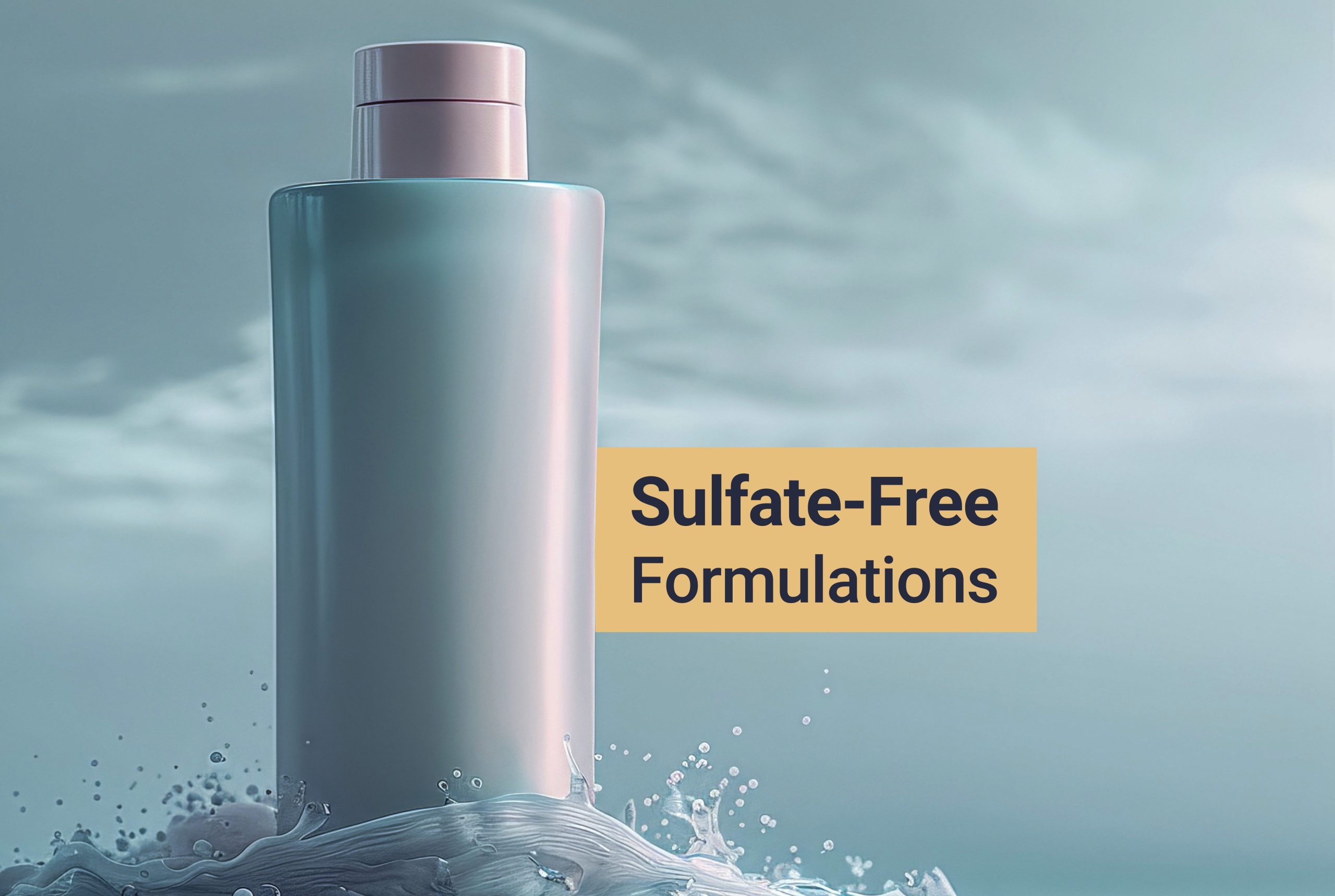
In recent years, the personal care industry has witnessed a significant shift toward sulfate-free formulations; a change largely driven by increasing consumer awareness of skin and hair health and their preference for milder and more body-friendly products. However, developing effective sulfate-free surfactant systems comes with specific technical challenges.
This article examines practical approaches for developing high-performance sulfate-free formulations; formulations that provide both effective cleansing performance and mildness.
Sulfate-Based or Sulfate-Free Shampoos? Reviewing Surfactant Performance and Effects
Sulfates are a type of surfactant widely used as detergent raw materials in shampoos, facial cleansers, soaps, and bath products to generate foam and remove oil and impurities from the skin and hair. However, these compounds can cause skin irritation and damage the protective barrier, which may result in dryness, inflammation, and sensitivity. In addition, the use of sulfate surfactants in hair care products may cause the color of dyed hair to fade more quickly.
Conventional shampoos have used Sodium Lauryl Sulfate (SLS) and Sodium Laureth Sulfate (SLES) as their primary surfactants for years. With the widespread emergence of sulfate-free options, important questions arise: Are these products truly milder and more suitable for sensitive skin and hair, or are they primarily marketing-driven?
Read more: The Role of Polyquaternium-7 in Skin Care Products
Advantages of Sulfates:
- Deep Cleansing: Sulfates are highly effective at removing heavy oils, sweat, and cosmetic product residues.
- Rich Foam: Many people consider foam a sign of cleanliness, and sulfates provide this sensation effectively.
- Affordable Price: Shampoos containing sulfates are usually less expensive.
- Suitable for Oily Scalp: If you have excessive oil at the roots of your hair, sulfates can quickly remove it.
Disadvantages of Sulfates:
- Over-Cleansing: In addition to impurities and oil, sulfates can also remove the hair’s natural moisture and protective layer.
- Hair Color Fading: These compounds open the hair cuticle and cause color molecules to be released.
- Potential Irritation: For people with sensitive skin, sulfates may cause inflammation or dryness.
- Hair Dryness and Frizz: Particularly in curly, wavy, or chemically treated hair, sulfates can cause dryness and frizz.
Challenges of Sulfate-Free Shampoo Formulation
Sulfate surfactants have been widely used in traditional formulations due to properties such as high effectiveness, affordable cost, ease of formulation, and easy thickening. However, sulfate-free alternatives do not offer many of these advantages. Therefore, when developing sulfate-free shampoos, you will face more challenges, including achieving suitable foam, desirable cleansing power, and maintaining production costs at an acceptable level.
In many cases, salt cannot be used to increase the viscosity of these types of formulations because salt does not perform optimally when combined with alternative surfactants. Therefore, you may need to use supplementary viscosity-building systems to maintain the product’s texture and performance.
Further Reading: Formulation Strategies for Producing Popular Detergents (4 Key Strategies)
Can the Viscosity of All Sulfate-Free Products Be Easily Increased?
Some sulfate-free surfactants have greater ease of viscosity building than others. For example, Alpha Olefin Sulfonate (Alpha Olefin Sulfonate) is one of the economical options among sulfate-free surfactants, and its viscosity can be increased easily in the formulation. In contrast, glutamate-based surfactants (glutamate-based surfactants) (derived from amino acids (amino acids)) are known for their high mildness and pleasant sensory properties, but achieving stable viscosity in their formulations is much more difficult and requires more specialized approaches in product design.
What Happens When We Combine Different Surfactants?
From a chemical perspective, combining primary surfactants with co-surfactants (co-surfactants) changes the average polar surface of the surfactant molecule, a factor that affects micelle structure. These changes allow formulators to adjust and optimize the final performance of the product.
In addition, combining different types of sulfate-free surfactants can improve properties such as cleansing power, foaming, and the consumer experience. However, such combinations make the viscosity-building process more complex and require more specialized approaches in formulation design.
How Can Formulators Increase the Viscosity of Sulfate-Free Formulations?
To increase viscosity in these types of formulations, formulators modify the structure of micelles (micelles). There are three main approaches to shaping micelles:
- Changing the shape from spherical to elongated and narrower: by using co-surfactants such as Cocamidopropyl Betaine
- Increasing the amount of salt: which, when combined with co-surfactants, can have a greater effect on changing micelle structure.
- Adding nonionic and hydrophobic thickeners such as Glyceryl Laurate or Laureth-2, which help increase formulation viscosity.
All of these steps help change micelles from a round and curved structure, making the formulation easier to thicken. However, the three methods mentioned above are generally more effective for sulfate surfactants. For sulfate-free cleansing products, conventional methods are often insufficient to achieve the desired viscosity or clarity.
Sulfate-Free Surfactant Classification:
| Surfactant Type | Examples | Key Characteristics |
| Amino Acid-Based | Sodium Lauryl Glutamate | Very high mildness, pH-sensitive |
| Alkyl Glucosides | Decyl Glucoside | Natural origin, good foaming |
| Sarcosinates | Sodium Lauroyl Sarcosinate | Mild with good cleansing power |
| Betaines | Cocamidopropyl Betaine – Cocamidopropyl Hydroxysultaine | Foam booster, helps increase viscosity |
Developing successful sulfate-free surfactant systems requires careful selection of alternative surfactants, the use of smart strategies for combining them, and comprehensive performance testing. By understanding the unique characteristics of sulfate-free surfactants and how they interact with one another, formulators can design products that meet expectations both technically and in terms of consumer satisfaction.
Padideh Shimi Jam, a knowledge-based company, is a chemical raw material manufacturer in Iran. To purchase and place an order for chemical raw materials, contact the sales experts at this company at 02188580000 or place your order online.
Sources:
https://www.applechem.com/blog/post/demystifying-sulfate-free-cleansing-formulations
https://groomingtalks.com/sulfate-free-vs-sulfate-shampoo-difference/